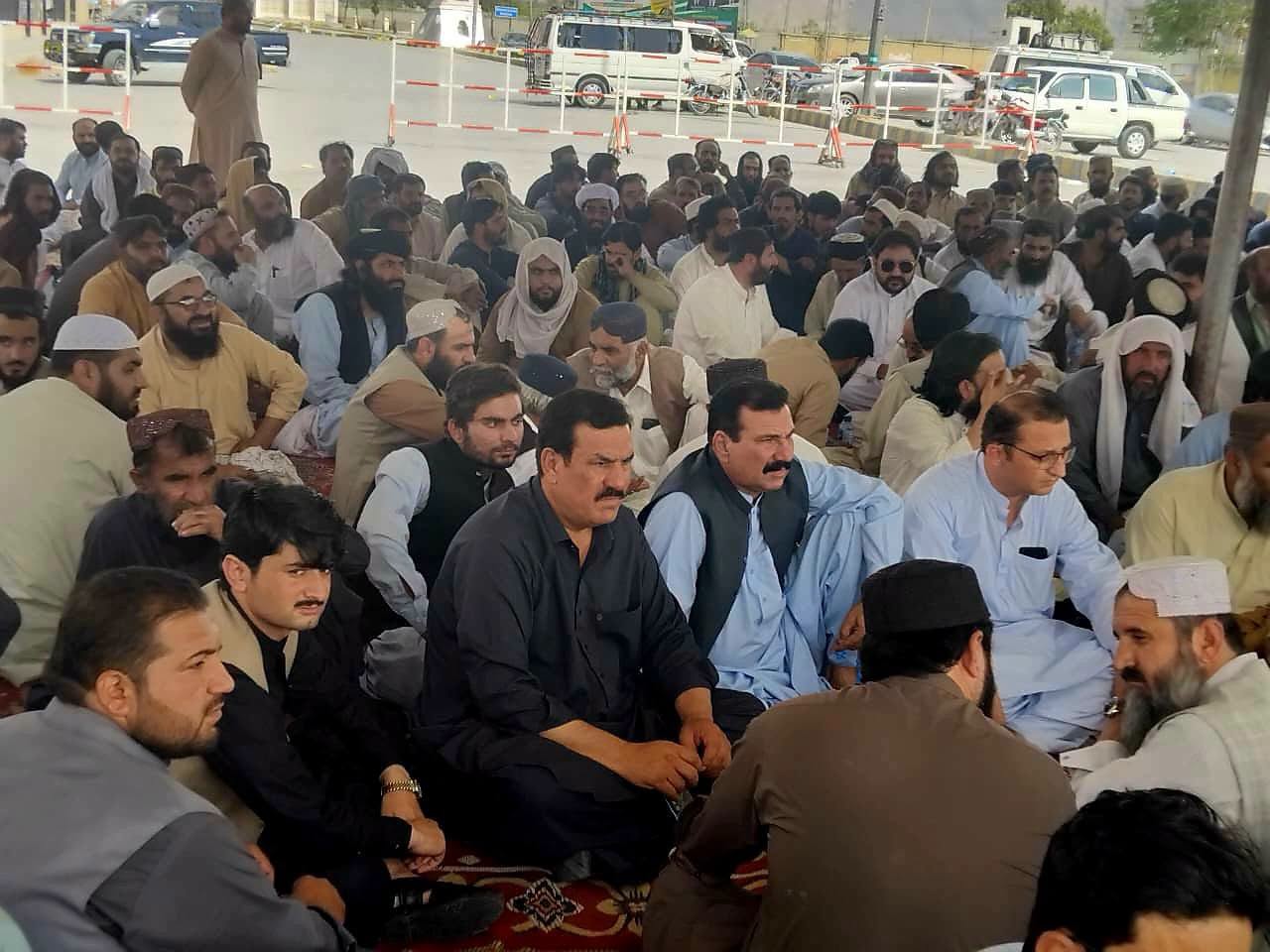
On the night of July 5, armed men descended on Killi Babri in Hanna Urak, on the outskirts of Quetta. By the time the guns fell silent, four residents lay dead, a fifth would later succumb to his injuries, eight were wounded, and eleven men had been taken away into the darkness. The victims' families refused to bury their dead for days, staging a sit-in on Airport Road that ended only after the Chief Minister himself sat across from them and the eleven abductees were recovered.
The provincial government has a tidy explanation: this was a Tehreek-e-Taliban Pakistan attack, repelled by brave locals standing "shoulder to shoulder" with security forces, followed by a sanitization operation in which militants were killed. Compensation has been announced. Jobs have been promised. The road has reopened. The file, presumably, is being closed.
But the people of Hanna Urak are telling a different story, and it deserves to be heard rather than managed. Protest leaders at the sit-in maintained, openly and repeatedly, that the men who attacked their village were not the TTP of official press briefings. They allege these are armed groups that have operated in the areas around Quetta with a freedom that genuine fugitives from the state do not enjoy, groups that residents say have been extorting villages across the Pashtun belt, styling their leaders as "commanders," and flaunting weapons on social media without consequence. And they allege that the violence in Hanna Urak is not senseless terrorism but has a logic: land.
That allegation cannot be independently verified, and we do not present it as established fact. But it cannot be dismissed either, because the historical record gives it uncomfortable weight.
On March 20, 2007, the Balochistan Assembly unanimously passed a resolution urging the federal government to stop the Air Force and Army from occupying the lands of the Bazai tribe in the suburbs of Quetta. The resolution, tabled by then provincial minister Maulana Abdul Rahim Bazai, named the areas: Aghbarg, Sra Ghurkai, Chasma Achozai, and Hanna and Urak. It stated that the tribe had held these lands for three centuries. Seven years later, in 2014, fourteen legislators jointly moved another resolution condemning the takeover of some 11,500 acres of Bazai land without market-rate compensation. That is not rumor. That is the province's own parliamentary record, spanning two decades, describing a persistent pattern of coveted land and displaced communities in precisely the places where blood was spilled this month.
So when the residents of Hanna Urak say they do not believe the official story, when they demand, as their central condition, "the complete elimination of armed groups" from their area rather than simply more checkpoints, they are not indulging in conspiracy. They are drawing on lived memory that the state itself once acknowledged on the floor of its own assembly, and then did nothing about.
There are other questions hanging over this affair that officialdom has shown no urgency to answer. Days before the Hanna Urak killings, on June 30, the Afghan Taliban claimed airstrikes on Saranan in Pishin district, Pakistan says it downed four drones, targeting what Kabul described as a "joint centre" of ISIS and anti-Taliban elements, reportedly housed in a former school. Islamabad confirmed the drone incursion but has said remarkably little about what, exactly, was operating at that site and under whose watch armed foreign-linked groups came to be encamped in the settled districts around the provincial capital. If there are armed camps in the Quetta valley's periphery, whoever runs them and whatever their purpose, the public whose villages border them has an absolute right to know.
Equally troubling is the silence around them. A village on the edge of the provincial capital was attacked twice in a week; five citizens were killed and eleven abducted; thousands sat on a major artery for five days refusing to bury their dead, and the story barely registered on national television. Balochistan's tragedies are routinely deemed newsworthy only when they can be slotted into a familiar security narrative. When the victims' own account complicates that narrative, the cameras look away. Civil society and the political parties that speak most loudly of rights have been scarcely more visible.
The government's agreement with the protesters is welcome as far as it goes: the abductees are home, compensation is promised, and the Apex Committee has taken notice. But an agreement that treats Hanna Urak as a one-off terrorist incident, to be compensated and forgotten, will settle nothing. What is required is what the protesters actually asked for: a credible, transparent accounting of who these armed men are, who if anyone enables them, and the permanent removal of every irregular armed group, of whatever affiliation, from the villages around Quetta. And it is long past time for the federal and provincial governments to resolve, openly and lawfully, the status of the Bazai lands that the assembly first raised nineteen years ago.
The people of Hanna Urak picked up whatever they had and defended their homes. Then they sat on a road with their dead and asked the state a simple question: who is killing us, and why? A state confident of its own answer would have no difficulty providing it. The evasions, so far, speak louder.

Comments
Leave a Comment
Your comment will be reviewed before it appears publicly.