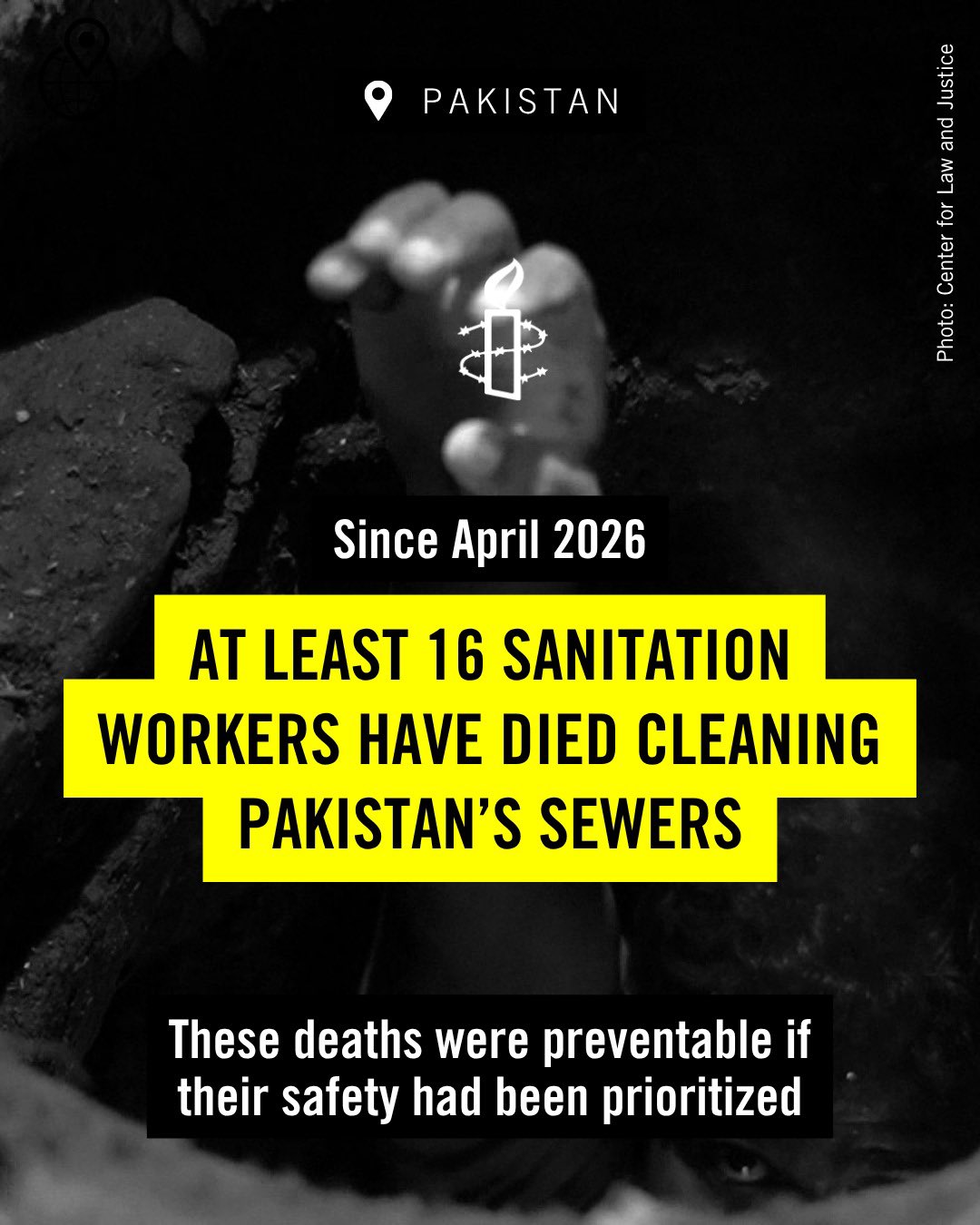
Two employees of the Chishtian Municipal Committee climbed into a manhole in Mahboob Colony on 4 July to clear a blocked sewerage line. Neither came out alive. Shafiq, 35, and Irfan Iqbal, 45, suffocated on the toxic gases trapped in the sewer; a third worker who went in after them was pulled out critically injured.the men had been sent down without safety gear of any kind, no masks, no harness, no gas testing.
Their deaths, Amnesty International said this week, are not an accident but a pattern: based on media reports, at least 16 sanitation workers have died in Pakistan since April 2026, most of them from suffocation and exposure to toxic fumes while manually cleaning sewers.
The rights organisation's statement catalogues a brutal three months for the workers who keep Pakistan's cities functioning. On 1 June, a sanitation worker was crushed to death by a vehicle while sweeping a road. Days later, a worker in Gujranwala set himself on fire after allegedly facing unpaid wages and unlawful salary deductions; he died of his injuries on 28 June. Reports indicate he had repeatedly raised his wage complaints before his death, and was heard by no one until it was too late.
In Chishtian, the aftermath followed a script Pakistan knows well: the municipal sanitary in-charge was suspended, a departmental inquiry was ordered, and Punjab Chief Minister Maryam Nawaz took notice and demanded a report. The families of the dead pointed out what every sanitation worker in the country already knows, that no protective equipment had been provided and no safety protocol was followed. Similar inquiries have followed similar deaths for years. The deaths continue.
Last year, Amnesty International and the Centre for Law & Justice published a landmark report on Pakistan's sanitation workforce with a title taken from a worker's own words: "Cut Us Open and See That We Bleed Like Them." Its findings: sanitation work in Pakistan is assigned along lines of caste and faith. The workforce is overwhelmingly drawn from Christian and Hindu communities, some job advertisements have explicitly reserved sanitation posts for non-Muslims, and these workers are disproportionately given the most dangerous and degrading tasks: manual cleaning of sewers, drains and latrines, frequently without protective gear, fair wages, formal contracts or job security.
The report found many workers employed for years on daily-wage or contract terms with no pension, no medical cover and no compensation path when they are injured or killed. When a worker dies in a manhole, his family's negotiation typically begins from zero.
Every death in Amnesty's count occurred where media happened to be present, overwhelmingly in Punjab's cities. That is precisely why Balochistan should pay attention: the same manholes are cleaned the same way in Quetta, Khuzdar, Turbat and Sibi, by workers with even less visibility, weaker unions and thinner media coverage than their counterparts in Lahore or Gujranwala. No public register of sanitation worker deaths and injuries exists for this province. Absence of data is not absence of deaths.
What is documented is the wider condition of Balochistan's low-paid public workforce. Provincial government employees, sanitation staff among the lowest-paid of them, have been protesting for months under the Balochistan Employees' Grand Alliance, demanding the 30 per cent Disparity Reduction Allowance and a minimum wage linked to inflation. The protests have shut highways and government offices and been met, at points, with police crackdowns and arrests. A workforce that must strike for months to be paid fairly is not a workforce that can refuse an order to climb into an untested manhole.
None of this requires invention. The measures rights groups and unions have demanded for years are standard practice elsewhere: a legal prohibition on manual sewer entry except in genuine emergencies, with mechanised cleaning equipment procured by municipalities; mandatory gas detection, harnesses, breathing apparatus and training where entry is unavoidable; regularisation of sanitation workers with pensions, medical cover and statutory compensation for death and injury; and enforcement of occupational safety laws against the officials who order unprotected entry, not only suspension after a funeral.
Sixteen families since April are owed more than inquiries. The men who died in Chishtian's sewer were sent there by a public institution, doing public work, for the public's benefit. The least the public owes them is to know their names, Shafiq and Irfan Iqbal, and to refuse to accept that the next name is inevitable.
Balochistan Dispatch covers labour rights across the province and the country. If you are a sanitation worker in Balochistan, or a family member of one, and want to speak about working conditions, anonymously if needed, contact us through our contact page. Sources for this report: Amnesty International, Dawn, The Nation, and the Amnesty International, Centre for Law & Justice report "Cut Us Open and See That We Bleed Like Them" (2025).


Comments
Leave a Comment
Your comment will be reviewed before it appears publicly.