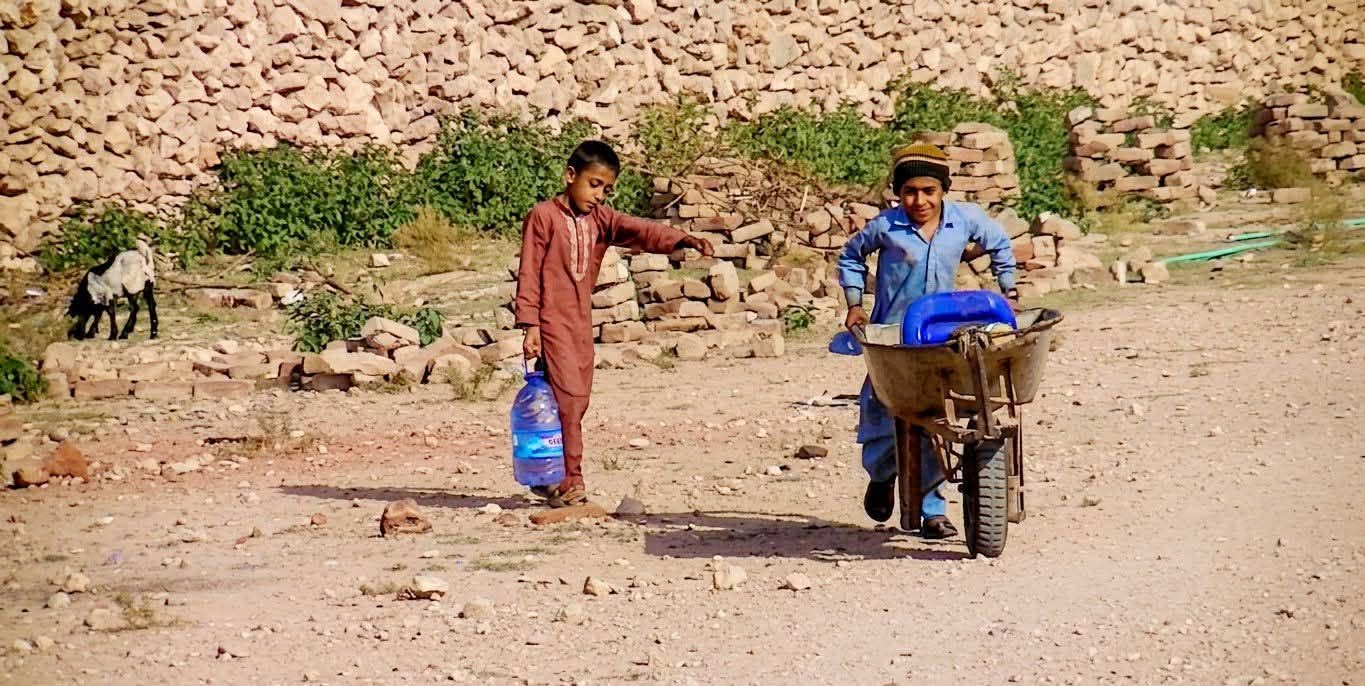
Nearly 62 percent of Balochistan's population lacks access to safe drinking water, and over 58 percent of the province's land lies uncultivable due to water scarcity. In villages like Dasht Karkak, and across Jaffarabad, Dera Bugti and Khuzdar, families routinely walk 5 to 10 kilometres to fetch water for their households, a daily labor that has become normal life in "the modern era."
This is not a crisis of one district. It is the story of an entire province standing on an emptying aquifer.
The Scale of the Problem
Balochistan is Pakistan's largest province by area, but it is also its driest. Academic research confirms what residents already live through: over 90 percent of the province depends entirely on groundwater because surface water is seasonal and disappears almost as fast as it flows (Akhtar et al., 2021). More than 72 percent of Balochistan's rural population depends on dug wells and streams for drinking water, sources that are increasingly contaminated or dry.
The numbers on the ground match this bleak academic picture:
- Quetta, the provincial capital, needs an estimated 50 million gallons of water a day. The Quetta Water and Sanitation Authority (QWASA) can supply only around 30 million gallons, leaving a daily shortfall of roughly 20 million gallons.
- Over 6,000 tube wells currently supply water across Balochistan's districts, but rising population has outpaced this supply, creating recurring shortages.
- Of the 417 tube wells installed by the government in recent years, more than 100 are non-functional, providing no relief to communities depending on them.
- In Gwadar, after three consecutive years of drought, roughly 100,000 residents have lost access to clean drinking water. Locals are forced to buy tanker water at USD 115-140 per delivery, or wait for subsidized water trucked in from 80 kilometres away.
Gwadar's crisis is not new, it is the second major water emergency to hit the port city and its surrounding areas in six years, despite repeated promises that CPEC-linked dam projects would resolve the shortage. even though spent Rs 11 billion water projects etc.
Why the Water Is Disappearing: The Root Causes
1. Geography and Climate
Balochistan's terrain works against it. Because of the province's steep slopes, surface water is ephemeral, it runs off rapidly rather than collecting in usable reservoirs (Akhtar et al., 2021). Annual rainfall averages below 200mm in most of the province, among the lowest in the region (Salma et al., 2012; Farooq et al., 2007).
2. Drought
Balochistan endured a six-year drought from 1998-2004, its longest documented dry spell, with rainfall dropping 50-60% below normal for the entire period (Bhatti et al., 2008; Ahmad, 2007). In the Quetta Valley alone, the water table fell by 18 to 24 metres a year during this period (Halcrow Pakistan and Cameos, 2008), and crop production dropped by roughly a third.
3. Groundwater Over-Extraction
The number of tube wells in Balochistan's upland basins grew from 10,971 in 1993 to over 21,000 by 2008, a 94% increase (Khair and Culas, 2013). District Quetta's aquifer is expected to run dry within roughly a decade if extraction continues unchecked (Khair et al., 2011). Illegal, unregulated boring, the same practice your reporting describes as "on the upswing", is accelerating this decline, since Balochistan currently has no functioning authority to control groundwater pumping (Halcrow, 2007).
4. Failure to Build Storage Infrastructure
Despite decades of warnings, the province has built tube wells rather than dams. Balochistan currently has only a small number of major dams (Hub, Mirani, Akra Kaur, Naulong, and others) plus roughly 300 smaller delay-action dams meant to slow flood runoff and recharge aquifers, but these capture only a fraction of the water that could be stored (Nippon Giken Inc and Halcrow, 1997; 2008). Without storage, over 79% of surface water runoff is lost without any economic use (Halcrow, 2007).
5. Agriculture's Heavy Draw
Agriculture consumes the overwhelming majority of Balochistan's water, employing 67% of the province's labor force and contributing over half of provincial GDP (Ali and Kakar, 2018). Irrigation systems operate at only about 45% efficiency due to poor infrastructure and outdated flood-irrigation methods, meaning much of the water drawn from the ground is wasted before it ever reaches a crop.
6. Electrical Power and Illegal Wells
Government-subsidized electricity for tube wells (funded at roughly 90%) encouraged large-scale extraction, replacing traditional karez systems that had sustainably fed groundwater for centuries. Unreliable, low-voltage power supply has, perversely, pushed farmers toward operating more wells to compensate, compounding the depletion (Khair et al., 2010).
7. Contamination
Even where water exists, it is often unsafe. Field surveys have found groundwater in numerous districts contaminated with arsenic, fluoride, nitrates, and disease-causing microorganisms.
Notably, in Jaffarabad, high fecal coliform contamination has been directly linked to floodwater carrying human and animal waste into wells and surface sources, a major driver of infectious disease in the district (Sarfraz et al., 2018).
The Water Balance: More Demand Than Supply
Provincial data shows just how thin the province's margins are. In several major river basins, water use already exceeds sustainable recharge:
What Could Actually Fix This
Researchers and policy reviews converge on a consistent set of interventions, measures your reporting on Dasht , Gwadar and Jhal Magsi suggests are urgently needed on the ground, not just on paper:
1. Basin-wide water monitoring, Balochistan currently manages water district-by-district with no unified system tracking extraction against recharge (Akhtar et al., 2021).
2. Karez rehabilitation, Restoring the province's roughly 1,000 traditional karez systems, many abandoned in favor of tube wells, would relieve pressure on the water table using proven ancient infrastructure (Memon et al., 2017).
3. Regulating tube well drilling, Introducing enforceable limits, particularly in basins already in deficit like Pishin Lora, Zhob and Qilla Saifullah.
4. Building actual dams, not just wells, Delay-action and storage dams average a 19% internal economic rate of return, according to feasibility studies (Halcrow Pakistan and Cameos, 2008), meaning dam construction is not just an environmental fix but a sound public investment.
5. Shifting to low-delta, drought-resistant crops, Farmers in badly hit districts have already begun shifting toward crops like grapes, almonds and cumin as water dries up; formal government support could scale this shift province-wide.
6. Artificial aquifer recharge, Actively directing floodwater and monsoon runoff back into depleted aquifers rather than letting it run off unused.
7. Public awareness and conservation campaigns, To reduce the wasteful 55%+ inefficiency currently built into irrigation practices.
The Bottom Line
The story from Dasht Karkak, Jhal Magsi, Dera Bugti and Khuzdar is the same story documented in the province's water balance sheets: demand has outrun supply for decades, unregulated tube-well drilling is accelerating collapse, and the infrastructure, dams, karez systems, monitoring networks, that could have prevented today's crisis was never built. Gwadar's tanker economy, at $115-140 a delivery, is what happens when that failure reaches a city's front door.




Comments
Leave a Comment
Your comment will be reviewed before it appears publicly.