A government notification dated July 8 has quietly reshaped the map of Pakistan's largest province, creating three new divisions, splitting Quetta in two, and reviving a naming dispute that reaches back to 1948.
QUETTABalochistan now has 11 administrative divisions and 41 districts, up from eight divisions in earlier years, after the provincial government's Revenue Department issued a sweeping notification restructuring how the province is governed at almost every level, from division down to sub-tehsil.
The order, Notification No. 294 A 13/L/21-98, dated July 8 and issued under Sections 5, 6 and 6-A of the Balochistan Land Revenue Act, 1967, was signed by the Board of Revenue and touches nearly every corner of the province: new divisions carved out of old ones, districts detached and reattached, tehsils upgraded, and at least three places quietly renamed.
Quetta, split down the railway line
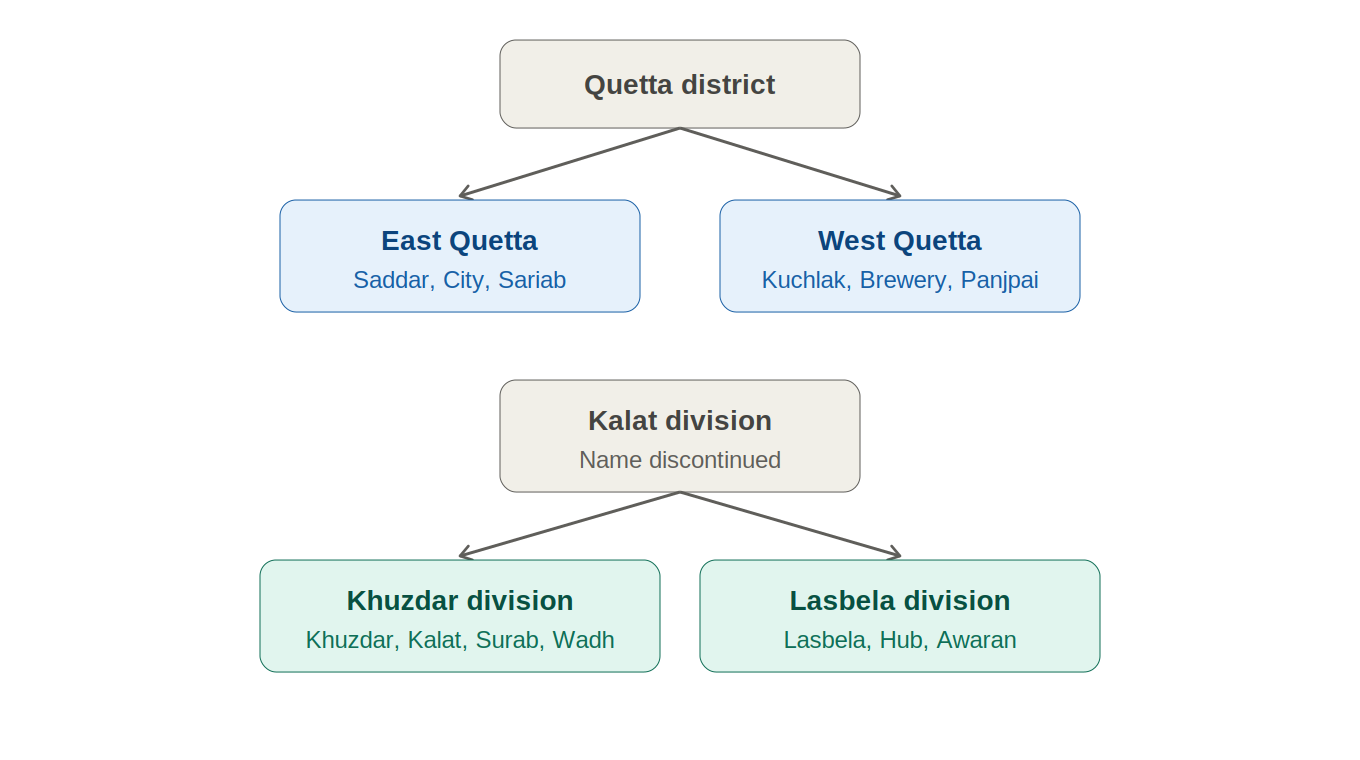
The most visible change is in the provincial capital itself. Quetta district has been bifurcated into East Quetta and West Quetta , divided along the railway line that runs through the city.
East Quetta now comprises the Saddar, City and Sariab sub-divisions, with its headquarters remaining at the existing Deputy Commissioner Quetta office. West Quetta consists of Kuchlak and two newly created sub-divisions, Brewery and Panjpai, with headquarters at Sariab, where the Irrigation Department building will now be repurposed as the office of the Deputy Commissioner, West Quetta.
A new Brewery tehsil has been created, and the notification specifies that Patwar circles in both new Quetta districts will be adjusted within one month by the Board of Revenue.
In the same stroke, Mastung district has been detached from Kalat division and placed under Quetta division , which now comprises three districts. This single line item has generated more political friction than almost anything else in the notification, more on that below.
Kalat division ceases to exist
In one of the more structurally significant changes, Kalat division has been bifurcated into two new divisions, Khuzdar and Lasbela, and the name "Kalat division" has been formally discontinued.
- Khuzdar division (headquarters: Khuzdar) now comprises Khuzdar, Kalat, Surab and the newly created Wadh districts.
- Lasbela division (headquarters: Uthal) comprises Lasbela, Hub and Awaran districts.
Within Khuzdar district itself, new Baghbana and Moola sub-divisions have been created, a new Zeedi tehsil introduced, and Karkh upgraded from sub-tehsil to full tehsil status. Khuzdar's Saroona sub-tehsil has been dissolved, with its Shahnoorani and Kalghalo union councils folded into Lasbela's Kanraj sub-division, while Saroona's remaining territory, including the Sub Tehsil Saroona, has been detached and included in the new Wadh district instead.
Surab district formerly Shaheed Sikandarabad district, has reverted to the name Surab, reversing a renaming decision made only last year. Surab has also absorbed the Zehri sub-division and tehsil, detached from Khuzdar.
Wadh district is entirely new, created from three sub-divisions, Wadh, Ornach and Nal, all detached from Khuzdar.
A quiet spelling correction with historical weight
Two long-contested spellings have been formally changed. Makran division will now be spelled Makuran, and Sibi division and Sibi city have been "rectified" to Seviboth framed in official language as corrections rather than renamings, though both touch on longstanding debates over the province's place names and their linguistic origins.
Dera Bugti district has also been split administratively in naming terms: Upper Dera Bugti is now North Dera Bugti, and Lower Dera Bugti is now South Dera Bugti.
Changes across the rest of the province
The notification's reach extends well beyond Quetta and the former Kalat division:
- Naseerabad division: Jaffarabad district gains a new Khanpur tehsil, built from the Rojhan, Ghadi Mehmood and Samoon patwar circles. Sohbatpur district gains a new Jia Khan sub-division and tehsil. Jhal Magsi's Mirpur sub-tehsil is upgraded to full tehsil.
- Zhob division: A new Murgha Kibzai sub-division and tehsil have been created in Zhob district.
- Pishin division: Largely unchanged territorially, but Barshore district gains a new Toba Kakari sub-division (headquartered at Behram Khan) and sees its own Barshore sub-tehsil upgraded to tehsil status.
- Rakhshan division (headquarters: Kharan): Chagai tehsil has been upgraded to a full sub-division, and Yak Mach sub-tehsil upgraded to tehsil. Washuk district gains a new Nag sub-division, with Nag sub-tehsil upgraded to tehsil.
- Makuran division (headquarters: Kech): A new Balnigore sub-division has been created by bifurcating the Dasht sub-division, and Sub Tehsil Balnigore has been upgraded to full tehsil. In Gwadar district, new Ormara and Jiwani sub-divisions have been established.
- Mastung district, now under Quetta division, retains Mastung, Dasht, Khad-e-Kocha and the newly created Kirgdgap sub-tehsil.
The politics behind the map
Redrawing district boundaries in Balochistan is never purely a technical exercise, and this notification is no exception. The shift of Mastung from Kalat to Quetta division drew public objection before the notification was even finalised: tribal chiefs and political leaders from the Sarawan region, along with senior politician Nawabzada Haji Lashkari Raisani, argued that altering Mastung's historical administrative status violates the 1948 accession agreement signed between the Khan of Kalat and Muhammad Ali Jinnah, an agreement that continues to carry deep symbolic weight in debates over the region's political history. Opposition members have separately walked out of the Balochistan Assembly over the broader package of new divisions and districts, reflecting wider unease that boundary changes of this scale were pushed through with limited public consultation.
That tension is worth holding onto as this restructuring moves from notification to implementation. Administrative boundaries determine far more than which office a citizen visits for a land record, they shape resource allocation, representation, and, in a province where center-versus-periphery grievances run deep, how much say local communities have in decisions drawn up in Quetta or Islamabad. Whether this reorganisation improves service delivery on the ground, or simply adds new layers of bureaucracy to navigate, will only become clear once the new district and tehsil offices are actually functioning.
This report is based on the original Board of Revenue notification (No. 294 A 13/L/21-98, dated July 8, 2026) and cross-referenced against reporting by Dawn (July 11, 2026). Implementation timelines, including Patwar circle adjustments, are pending as of publication.


Comments
Leave a Comment
Your comment will be reviewed before it appears publicly.