Security forces say 114 militants have been killed since July 5. The bigger question, one the death tolls alone don't answer, is why this province keeps arriving at moments like this one.
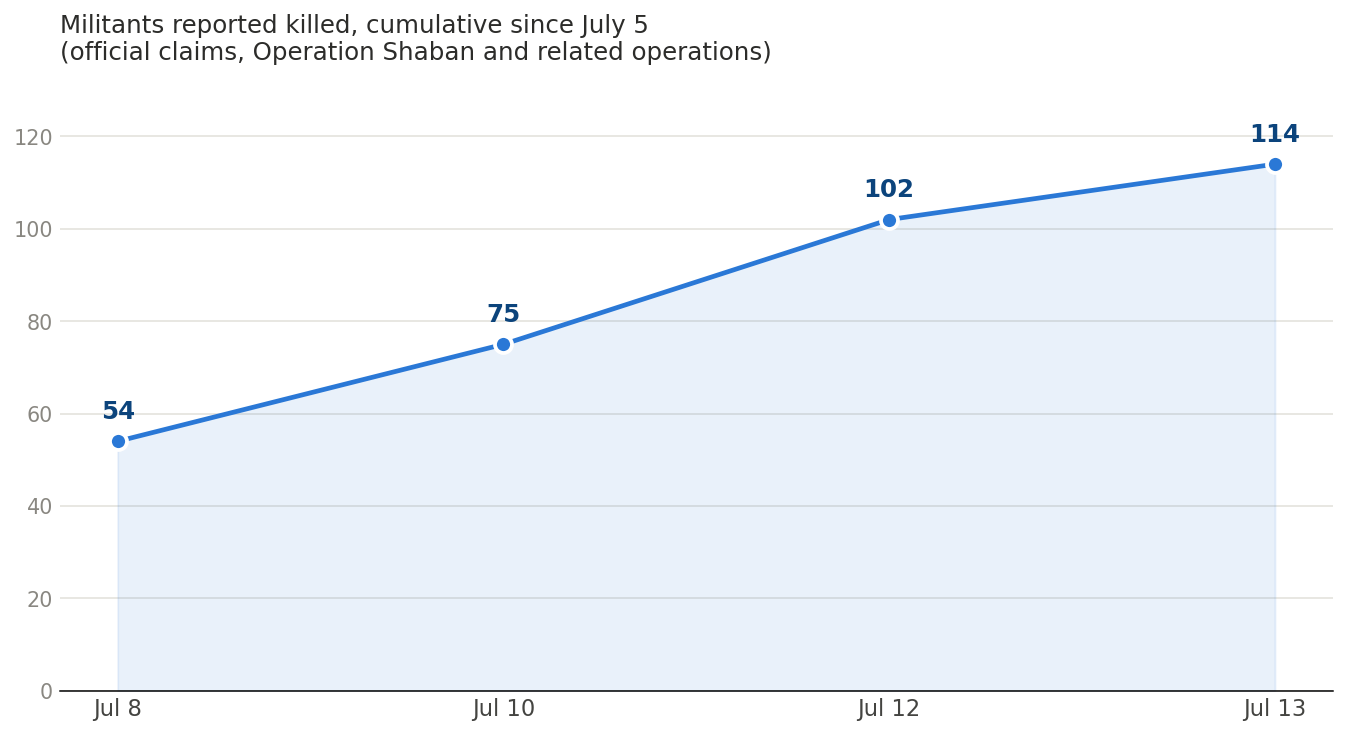
QUETTA/ISLAMABADPakistani security forces have killed five more suspected militants in an ongoing operation in Balochistan, state broadcaster Radio Pakistan reported Monday, taking the death toll under Operation Shaban specifically to 76, and the combined total from Shaban and other intelligence-based operations since July 5 to 114.
The operation is being run jointly by the Pakistan Army, Frontier Corps Balochistan and Balochistan Police, and security officials have said it will continue until, in their words, the last militant is eliminated.
How we got here
The current crackdown traces back to a wave of coordinated attacks that began July 5. The most consequential came on July 7, when militants stormed a police post in the Mangi Dam area of Ziarat district, killing nine police personnel and abducting 18 others at gunpoint. The abducted officers were later found dead in the mountainous Zarghoon Gar area. A separate ambush on an army convoy followed on July 8 in the Bela-Winder area of Lasbela district. Pakistan's military says the combined attacks killed 42 people, most of them security personnel.
Operation Shaban was launched in direct response to the Mangi Dam attack. The military's reported kill count has climbed steadily since: 54 militants in the first days, rising past 100 by July 12, and to 114 as of Monday's update, a pace of near-daily announcements from state media that itself has become part of the story.
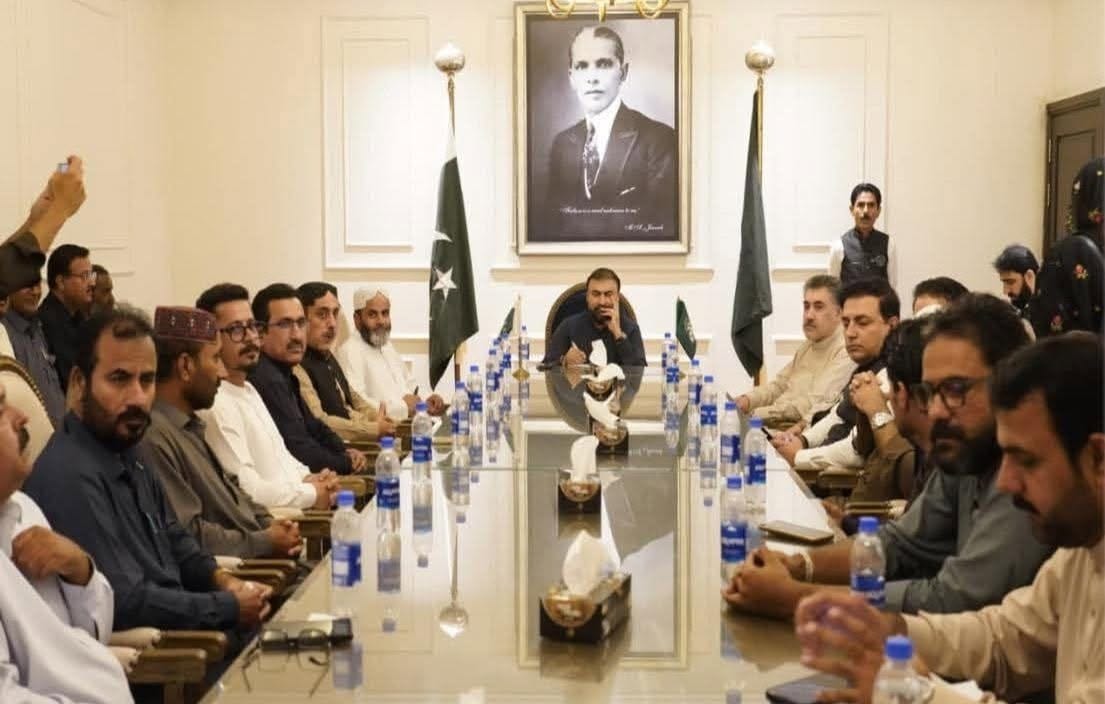
Prime Minister Shehbaz Sharif, addressing a Provincial Apex Committee meeting in Quetta alongside Chief of Defence Forces Field Marshal Asim Munir, described the response as a "mutual and singular decision" by the country's civil and military leadership to end terrorism collectively. The government has also pointed abroad, with Sharif blaming Pakistan's "eastern neighbour", a reference to India, for backing the attacks, and officials separately accusing Afghanistan of providing safe haven to militant groups. Both New Delhi and Kabul have denied these allegations, as they have in previous rounds of similar accusations.
The numbers nobody can fully verify
It is worth being direct about something straight news coverage often glosses over: the casualty figures driving this story come almost entirely from one side. State broadcasters and security sources, largely speaking on condition of anonymity, supply the running tally of militants killed. There is no independent, on-the-ground verification process for these numbers, and Balochistan's rights groups, including the Human Rights Council of Balochistan, along with independent commentators, have repeatedly raised concerns in past operations that individuals counted as militants killed in operations were, in some documented cases, previously reported as forcibly disappeared civilians. Those allegations remain unverified in this specific operation, but the pattern has recurred often enough in previous years that it is a standing caveat, not a fringe objection, and it applies to Operation Shaban's figures just as it has to previous ones.
Why this keeps happening
Balochistan is Pakistan's largest province by land area and its least developed by most standard measures, despite sitting on significant mineral wealth and hosting some of the country's largest strategic investments, including the Chinese-backed deep-sea port at Gwadar and China-Pakistan Economic Corridor infrastructure. That gap between the province's resource wealth and the living standards of many of its residents is the grievance that Baloch nationalist movements have organized around for decades, and it predates the current wave of violence by generations, Balochistan has seen at least five separate uprisings since Pakistan's independence in 1947.
Armed groups including the Balochistan Liberation Army, which Pakistan, the United States and the European Union have designated a terrorist organisation, frame their campaign as resistance to what they describe as the extraction of the province's resources without commensurate benefit to its population, alongside long-running grievances over enforced disappearances of Baloch political activists and students, a practice Balochistan's rights groups have documented for years and which successive Pakistani governments have denied conducting as state policy. Separately, the province has also become a battleground for religiously motivated militant groups, including the Tehreek-e-Taliban Pakistan, whose objectives and leadership are distinct from the Baloch nationalist movement even where their attacks sometimes overlap in target and timing.
This is, in other words, at least two conflicts layered on top of each other, a decades-old ethno-nationalist insurgency with specific, articulated grievances about resource control and disappearances, and a separate militant Islamist campaign, and official statements attributing violence to "terrorism" broadly, or to foreign backing exclusively, tend to compress that distinction rather than explain it. An opposition-aligned political forum in the Balochistan Assembly has separately called this month for political dialogue, an end to enforced disappearances, and a truth and reconciliation commission, a position that treats the underlying grievances as a political problem requiring a political response, distinct from the security establishment's framing of the moment as one requiring military resolve alone.
Whether Operation Shaban ends this cycle or simply resets the clock to the next one is not a question the kill counts can answer. That answer, if it comes, will show up in whether the province's underlying grievances, resource distribution, disappearances, political representation, are addressed once the operation winds down, not in how high the tally climbs before it does.
This report draws on Dawn and Radio Pakistan coverage published July 11-13, 2026, official statements from ISPR and the Prime Minister's Office, and documentation from the Human Rights Council of Balochistan. Casualty figures attributed to security sources are official claims and have not been independently verified.

Comments
Leave a Comment
Your comment will be reviewed before it appears publicly.