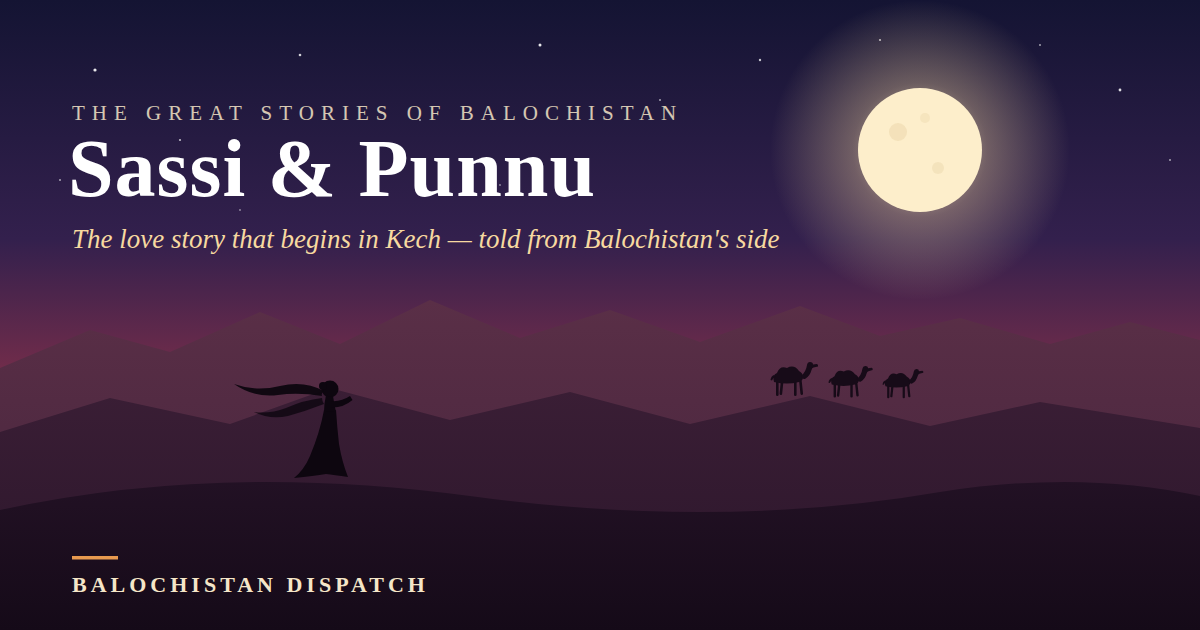
Part of our series on the great stories of Balochistan, the legends, romances and epics that shaped the province's identity.
Every Pakistani knows how the story ends: a woman runs barefoot into the desert after a caravan she will never catch, and the earth itself opens to take her grief. Sassi and Punnu is sung in Sindhi by the followers of Shah Abdul Latif Bhittai, performed in Punjabi theatre, referenced in films and ghazals across the subcontinent.
But listen to where the story actually happens. The prince is Baloch. His city is Kech, in the heart of Makran. His fort still stands outside Turbat. The caravan road Sassi died on runs through Balochistan, and the grave where the lovers lie together is in the hills of Lasbela, barely an hour and a half from Karachi, visited by devotees to this day.
Sindh gave the story its poetry. Balochistan gave it its hero, its geography and its grave. This is the telling from our side of the mountains.
A daughter set adrift
As the story is told, Sassi was born to a ruler of Bhambore, the ancient port city on the Indus delta. At her birth, the astrologers read her stars and warned the king: this daughter's love would bring the family disgrace. The king ordered the infant placed in a wooden chest and set adrift on the river.
The chest floated down to the crossing where a washerman of Bhambore worked the banks. He was childless; he took the girl as a gift from God and named her Sassi, moon, because, the singers say, her beauty already had that kind of light. She grew up a washerman's daughter, and Bhambore grew famous for her: travellers carried word of Sassi's beauty along the caravan roads the way they carried musk and dates.
The prince of Kech
Those caravan roads began in Makran. In Kech, the green river valley in the heart of what is now district Kech, Balochistan, ruled Jam Aari of the Hoth, a Baloch tribal dynasty, and his son was Mir Punnu Khan: Punnu of the Hoth, remembered as the handsomest man of his age.
Word of Sassi reached Kech with the traders. Punnu, as the story goes, could not rest until he had seen her. He joined a caravan carrying perfume and cloth to Bhambore, presenting himself not as a prince but as a merchant, and when Sassi and Punnu saw each other, the matter was decided in a glance. The singers do not waste verses explaining it. Some things are fate, and the stars had already spoken at Sassi's birth.
Her adoptive father set one condition, meant kindly: his daughter would marry a washerman, not a wandering trader. So the prince of Kech bent over the washing stones. He ruined every garment he touched, royal hands know nothing of laundry, and, in the version Baloch elders smile over, he slipped a gold coin into each bundle of ruined clothes so that no customer complained. The washerman consented. Sassi and Punnu were married in Bhambore.
The theft in the night
In Kech, the news landed like an insult. A prince of the Hoth, living in a washerman's house in Sindh? Punnu's brothers rode for Bhambore. They came smiling, embraced Punnu, celebrated the marriage, called for wine, and drank with him late into the night until he could not stand. Then they tied their sleeping brother onto a camel and rode for Makran in the dark.
Sassi woke at dawn to an empty bed and a cold trail of camel prints pointing west, into some of the harshest country on earth.
The crossing
What makes Sassi immortal is what she did next. She did not wait, and she did not mourn. She walked, barefoot, alone, without water, into the mountains after the caravan, along the old road toward Kech that threads what is now Lasbela district. The sun took her strength; the rocks took the skin of her feet; she called Punnu's name at every ridgeline.
In the hills, dying of thirst, she met a goatherd. When she understood that she was in danger from him, she prayed for the earth to protect her honour, and the earth split, and took her, leaving only a corner of her scarf above the ground. The shepherd, struck with terror and repentance, raised a grave of stones over the place.
Punnu woke in his brothers' camp to learn what had been done. He turned back, retracing the track along the same ridgelines, calling her name, and when he reached the fresh grave in the hills, the shepherd told him everything. Punnu prayed the same prayer. The earth opened a second time, and the lovers were buried together, united in the ground, as the world above had refused to allow.
Where the story still stands
This is not only a story on the tongue. You can visit it:
- The shrine of Sassi and Punnu, Lasbelathe lovers' tomb stands in the hills of Lasbela district, roughly 65 kilometres from Karachi, and still receives devotees who tie their hopes to the couple who defeated separation in death. It is among the very few shrines anywhere raised to a pair of lovers.
- Miri Kalat (Punnu's Fort), Turbatoutside Turbat in district Kech stand the ruins locals have always called Punnu ki Miri: Punnu's fort. Archaeologists have found layers here going back thousands of years, which is to say the fort was already ancient when the story attached itself to it. The Kech valley around it remains what it was, the date-palm heartland of Makran.
- Bhambore, Sindhthe excavated port city near Dhabeji, where the story begins. Sindh maintains a museum at the site.
Why Balochistan's telling matters
In the Sindhi tradition, above all in Shah Abdul Latif Bhittai's Shah Jo Risalo, which devotes five entire chapters to her, Sassi is the seeker, and the story is told through her devotion. It is one of the peaks of subcontinental poetry, and Balochistan claims no quarrel with it.
But in the Balochi telling, sung by generations of Makrani singers, the story carries different weight. Punnu is not a prop in someone else's tragedy: he is a Hoth prince caught between love and tribe, and the story is about what pride costs, the brothers' pride, which stole him from his marriage bed and killed two innocents. Kech's elders tell it as a warning about honour turned cruel. That telling belongs to Balochistan, and it deserves to be heard in Balochistan's voice.
Frequently asked questions
Is Sassi Punnu a true story?
It is folklore, centuries old, told in Balochi, Sindhi and Punjabi versions that differ in detail. The places, however, are real: Bhambore is an excavated city, Miri Kalat is a real archaeological site, and the shrine in Lasbela receives visitors today.
Where is Sassi Punnu's grave?
In the hills of Lasbela district, Balochistan, about 65 km from Karachi. It can be visited along with the Winder/Dureji area routes.
Who was Punnu?
Mir Punnu Khan of the Hoth tribe, son of Jam Aari, ruler of Kech in Makran, a Baloch prince. His fort, Miri Kalat, stands near modern Turbat.
What does Shah Abdul Latif Bhittai have to do with the story?
The great Sindhi Sufi poet (1689-1752) made Sassi one of the central heroines of his Shah Jo Risalo, treating her desert crossing as an allegory of the soul's search for the divine. His version carried the story across the world.
Next in this series: Hani and Sheh Mureed, the story of a betrothal broken by a king's trick, from the court of Mir Chakar Rind. For the places in this story, see our guide to 25 Places to Visit in Balochistan. Have a version of this story told differently in your district? Write to us via the contact pagewe want to record every telling.

Comments
Leave a Comment
Your comment will be reviewed before it appears publicly.