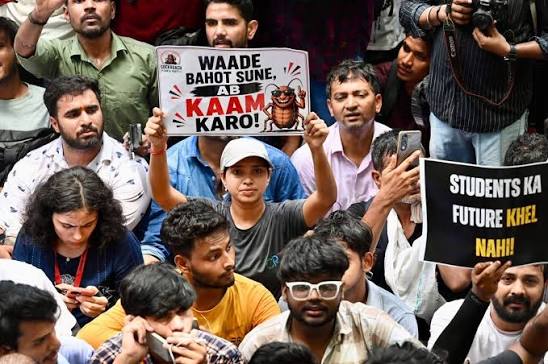
On Monday, more than 10,000 young Indians walked toward their own Parliament. They did not carry guns. They carried exam papers, homemade banners, and, in some hands, small cockroach masks. Police met them with tear gas and batons. By evening, streets around Jantar Mantar were full of coughing students, broken barricades, and a question that will not go away: is this the start of something much bigger?
This is the story of the Cockroach Janta Party how a judge's insult turned into India's loudest youth movement in years.
How It All Began: An Insult That Backfired
Go back to May 2026. India's Chief Justice, Surya Kant, was speaking during an unrelated court hearing. He compared some unemployed young people and online critics to "cockroaches" and "parasites of society." He later said his words were twisted out of context. But by then, it was too late the internet had already run away with it.
Instead of feeling insulted, young Indians did something clever. They picked up the word "cockroach" and wore it like armour. A political strategist named Abhijeet Dipke, who had earlier worked with the Aam Aadmi Party, founded a satirical movement on 16 May 2026. He called it the Cockroach Janta Party , a cheeky twist on the name of India's ruling party, the BJP. Its slogan: "Voice of the Lazy and Unemployed."
Within 78 hours, a single satirical Instagram page had crossed three million followers. Today, the movement's online following has climbed past 22 million. Cockroaches, after all, survive almost anything. That was the whole point.
What Do They Actually Want?
The party started as a joke. The anger underneath it was never a joke.
The Cockroach Janta Party's protest is rooted in India's exam system specifically the 2026 NEET medical entrance paper leak and irregularities in CBSE's on-screen marking process. For millions of Indian students, entrance exams decide their entire future. When exams leak or get mismanaged, years of a young person's life can collapse overnight. The movement says more than 20 students have taken their own lives because of this pressure and these failures.
Their core demands are simple and specific:
- The resignation of Union Education Minister Dharmendra Pradhan
- Real, transparent reform of how national exams are conducted and marked
- Compensation and accountability for families of students who died by suicide after exam-related failures
- The release of activists detained during the protests
Behind these demands sits a bigger, quieter anger, India's high youth unemployment, a rising cost of living, and a feeling among the young that the system simply does not listen to them.
For weeks, the Cockroach Janta Party kept things playful. Protesters mailed diapers to the education minister's office as a mocking symbol of "plugging the leaks." They danced and banged plates outside government buildings. It looked, at first, like clever street theatre.
Then, on 6 June 2026, protesters set up camp at Jantar Mantar, Delhi's famous protest ground, alongside student groups like the Students Federation of India and the All India Students Association. The tone shifted further on 28 June, when veteran Ladakhi activist Sonam Wangchuk arrived and began an indefinite hunger strike in solidarity. Wangchuk is a well-known face in India an educationist and environmentalist who has led earlier marches for Ladakh's rights. His presence pulled in older citizens, families, and civil society groups who had never joined the cockroach movement before.
Wangchuk fasted for three weeks. By the government's own telling, he lost more than 18 pounds. On Saturday, plain clothes police entered the protest site and forcibly carried him into an ambulance. That single image an elderly, respected activist being dragged away mid-hunger-strike is what turned a student protest into a national flashpoint.
Anger over Wangchuk's removal brought people out in numbers nobody expected. On Monday, 20 July 2026, more than 10,000 protesters tried to march from Jantar Mantar toward Parliament, defying a police ban on the march. Delhi Police, which answers directly to the BJP-led central government, responded with tear gas shells and baton charges. The Wire reported that thousands of people were injured, some seriously. Despite the crackdown, many protesters kept walking toward Parliament in small groups, refusing to turn back.
It was, by most accounts, the biggest and most violent confrontation the movement has seen since it began.
Even so, the government made a small opening. Health Minister J.P. Nadda met two Cockroach Janta Party spokespeople for about ten minutes at his residence. One spokesperson said the minister asked for more time to discuss the movement's demands. The education minister, Dharmendra Pradhan, has still refused to resign.
What Indian Human Rights Voices Are Saying
The crackdown has drawn sharp criticism from rights groups. Aakar Patel, board chair of Amnesty International India, said the scenes from Jantar Mantar show "how peaceful dissent is being suppressed in India." He said the role of authorities is to protect peaceful assembly, not suppress it, and questioned whether Delhi Police's response met basic standards of legality, necessity, and proportion under international human rights law. He called on police to immediately stop using unlawful force against peaceful protesters.
Political analysts are more divided on where this goes next. Some, like the Delhi University academic Apoorvanand, point out an important difference between this movement and the ones that toppled governments in Nepal and Bangladesh: those uprisings targeted the "whole system," while the Cockroach Janta Party's demands have so far stayed narrower, focused on the education minister and exam reform, not regime change itself. Other observers note that BJP supporters have dismissed the movement as a social media gimmick unlikely to survive past its viral moment.
Founder Abhijeet Dipke himself has firmly rejected comparisons to the uprisings in Nepal, Sri Lanka, or Bangladesh. "Do not insult or underestimate the Gen Z of India by making such comparisons," he wrote on X. He argues Indian youth are politically aware, committed to the constitution, and determined to protest peacefully rather than through the kind of upheaval seen elsewhere in South Asia.
Does This Look Like Nepal, Sri Lanka, or Bangladesh?
The comparison keeps coming up because the pattern feels familiar. Across South Asia, young people organizing first online and then on the streets have already reshaped entire governments:
- Sri Lanka, 2022: The Aragalaya ("struggle") protests, driven by economic collapse and anger at corruption, forced President Gotabaya Rajapaksa to resign.
- Bangladesh, 2024: Student-led protests against government job quotas grew into a mass movement that ended Sheikh Hasina's 15-year rule, though what followed included instability and attacks on minorities.
- Nepal, 2025: So-called "Gen Z protests," organized partly in secret on platforms like Discord, shook the country's old political parties, though the movement has not yet built a clear plan for what comes after protest.
The Cockroach Janta Party shares real similarities with all three: young organizers, heavy use of social media, and a spark that came from feeling disrespected by those in power. India's government has already blocked the movement's main X account and website inside the country and labelled it "anti-national" a sign officials are taking it seriously, whatever they say in public.
But most analysts stop short of predicting a Nepal-style or Bangladesh-style outcome at least for now. The movement has not shown, yet, that it can turn viral online anger into the kind of sustained, nationwide street mobilization that toppled governments elsewhere. Its demands remain focused on education and exam reform rather than a call to bring down the government itself.
The Bottom Line
What began as a joke about cockroaches has become one of the most serious tests of youth anger that India's government has faced in years. Whether it stays a protest about exams, or grows into something the size of what happened in Kathmandu, Colombo, or Dhaka, depends on what happens in the next few weeks, and on whether the government chooses dialogue over more tear gas.
For now, the cockroaches are still walking.
Reporting based on coverage from Al Jazeera, NPR, AP, Reuters, DW, the South China Morning Post, Nepali Times, Countercurrents, FairPlanet, and Amnesty International India statements. This report will be updated as the situation develops
Comments
Leave a Comment
Your comment will be reviewed before it appears publicly.