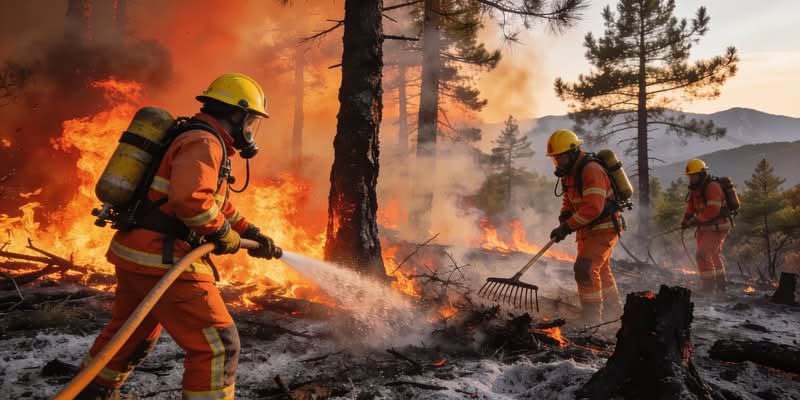
More than 300,000 people have fled their homes in France and Spain as wildfires tear across swathes of southern Europe, with the death toll rising and authorities warning of a difficult night ahead, according to figures released on Saturday.
In France, fires that broke out along the southwestern coast earlier in the week pushed inland towards the city of Bordeaux, forcing the evacuation of tens of thousands more people from its suburbs. Around 197,000 people have so far been moved out of the Gironde and Landes departments, where the main blaze which began in the town of Saumos on Tuesday has burned through roughly 32,700 hectares of tinder-dry pine forest.
https://youtu.be/xhkmXk5tYhM
French Prime Minister Sébastien Lecornu called the situation unprecedented, saying the Gironde fire had grown so intense it was generating its own winds. "Our priority is clear: protecting human lives," he wrote on social media, adding that evacuation orders must be obeyed without delay. President Emmanuel Macron deployed 1,000 soldiers to support firefighters near Bordeaux, and the government ordered a military transport aircraft, capable of dropping 20 tonnes of fire retardant, to join the effort.
Across the border, Spain recorded its first death from the fires an elderly man who died in his car during a brush fire outside the coastal city of Valencia. Three blazes near Madrid, two of which merged, prompted the Spanish government to declare its first national emergency over a wildfire, with more than 60,000 people evacuated or confined to their homes in the affected regions, including the province of Ávila.
High winds fanned the flames in both countries, complicating the work of firefighting crews. Spain's civil protection service said additional water-dumping aircraft were arriving from Italy and Greece as part of a European Union response, adding to planes already sent by the Netherlands and Portugal.
The coastline near Bordeaux, a popular tourist destination dotted with easily combustible pine forests and famed for its vineyards, has been among the worst affected. Shelters such as the city's exhibition centre were opened to house those forced from their homes.
Scientists have linked the fires to prolonged dry spells and repeated heatwaves that have gripped Europe this summer, conditions they say are being made more frequent and more severe by climate change. Temperatures this July across the fire-hit region of France have averaged well above the seasonal norm.
Authorities cautioned that the number of people displaced was likely to keep rising as the fires spread and further evacuation orders were issued.
-Balochistan Dispatch
Comments
Leave a Comment
Your comment will be reviewed before it appears publicly.