
Journalist Asad Ali Toor has petitioned the Islamabad High Court to quash a National Cyber Crime Investigation Agency (NCCIA) notice issued against him under the Prevention of Electronic Crimes Act (PECA), and has sent the agency a written reply demanding it first disclose the complaint and the specific allegations he is said to face.
Toor, who was summoned on 29 July to appear before the NCCIA's Cybercrime Reporting Centre in Islamabad on Friday, 31 July, said he had couriered his reply to the investigating officer the same evening rather than wait for the appearance date. In it, he said he was willing to cooperate with the inquiry but could not meaningfully respond to allegations of which he had not been informed.
The notice, Toor argued, disclosed no material particulars confining itself to a generic reference to the "alleged dissemination, transmission and/or public exhibition of false/fake information" without identifying the specific post, publication or statement said to be false, the date and manner of its dissemination, or any aggrieved party. He said he had not been provided with a copy of the complaint on which the enquiry (No. 2220/26) was registered, nor the content alleged to be false.
https://x.com/AsadAToor/status/2082853526351536144?s=20
Citing the right to a fair trial under Article 10A of the Constitution, Toor wrote that a person called upon to answer an allegation must first be informed of its particulars, and that disclosure of the case against him was a condition precedent to any obligation to respond. He asked the agency to provide the complaint, the specific content alleged to be false along with its date and medium, and any other material forming the basis of the allegations before the appearance date.
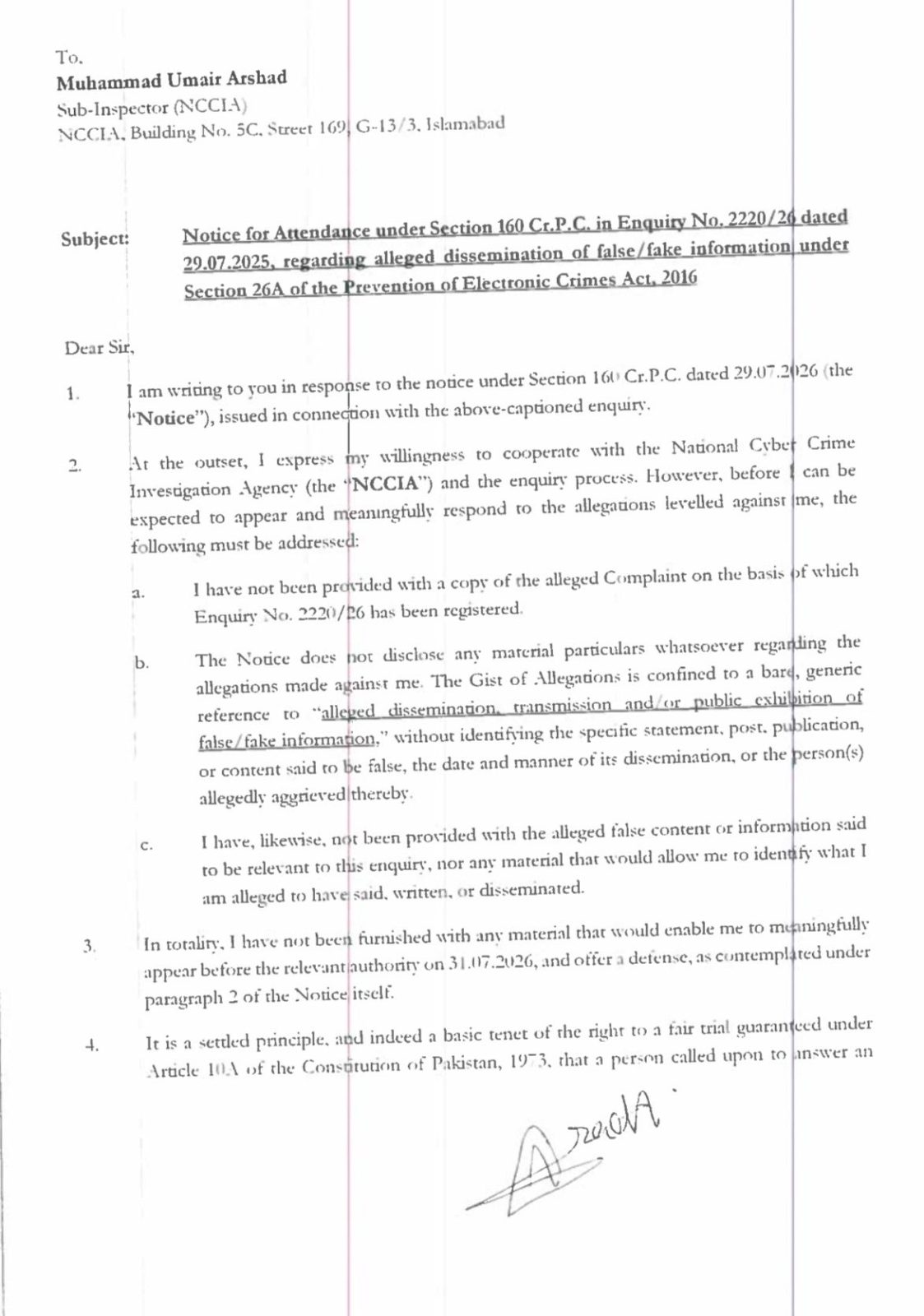
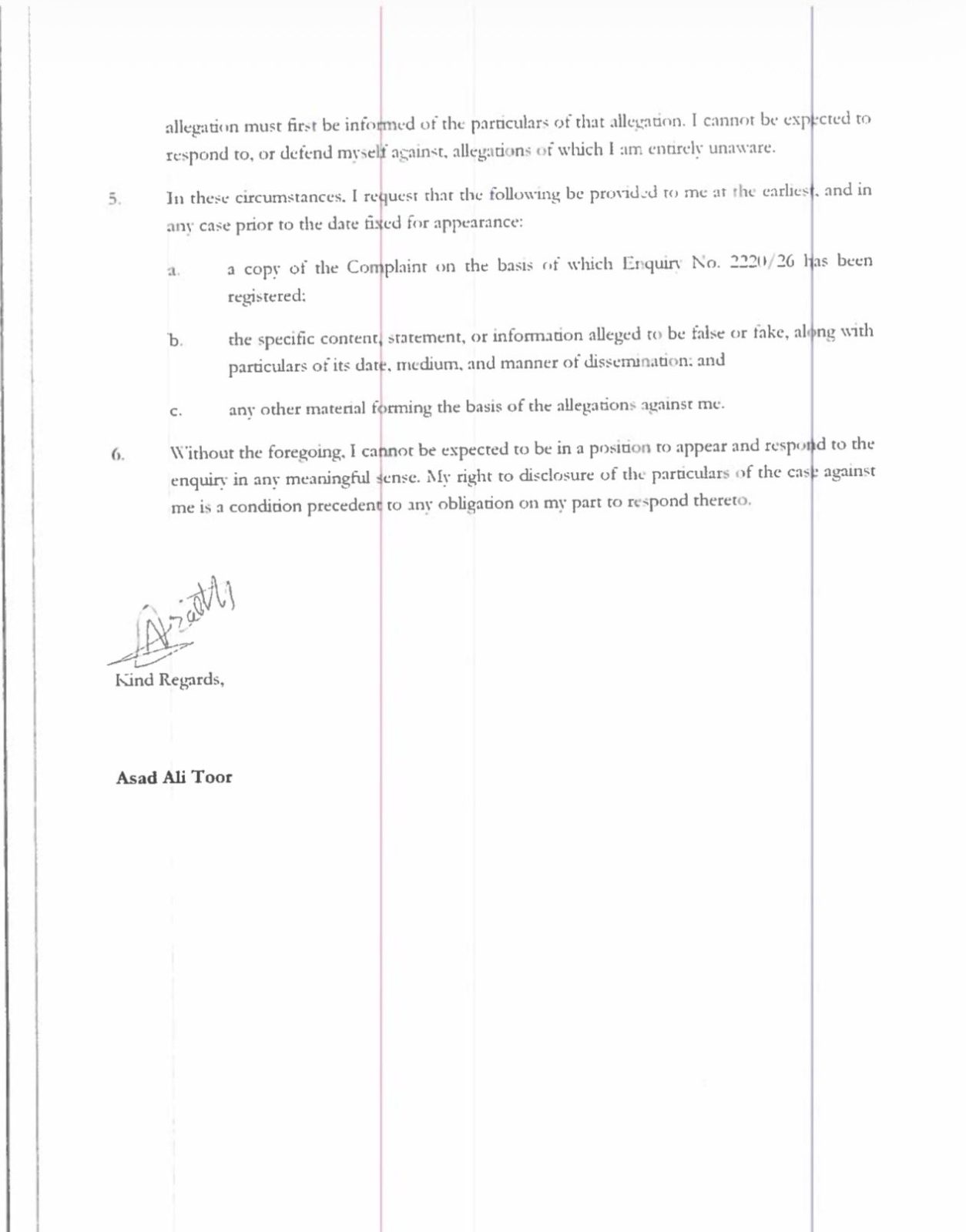
Toor said he had also approached the Islamabad High Court in the matter, and that his petition had been fixed for hearing on Friday morning before Justice Azam Khan.
The summons was issued on a complaint that names the state as the complainant, under Section 26A of PECA a provision that criminalises the intentional spread of "false or fake" information deemed likely to cause fear or public disorder, and carries up to three years' imprisonment or a fine. Rights groups, press bodies and lawyers have criticised the clause as vaguely worded and warned that it is being applied against journalists and online commentators.
The National Press Club in Islamabad earlier condemned the notice and demanded its withdrawal. Toor, whose YouTube channel was among several blocked under PECA in 2025, has been the subject of repeated legal actions in recent years.
He is due to appear before the NCCIA on 31 July, the same morning his high court petition is listed for hearing.
Published in Balochistan Dispatch, July 30th, 2026




Comments
Leave a Comment
Your comment will be reviewed before it appears publicly.